
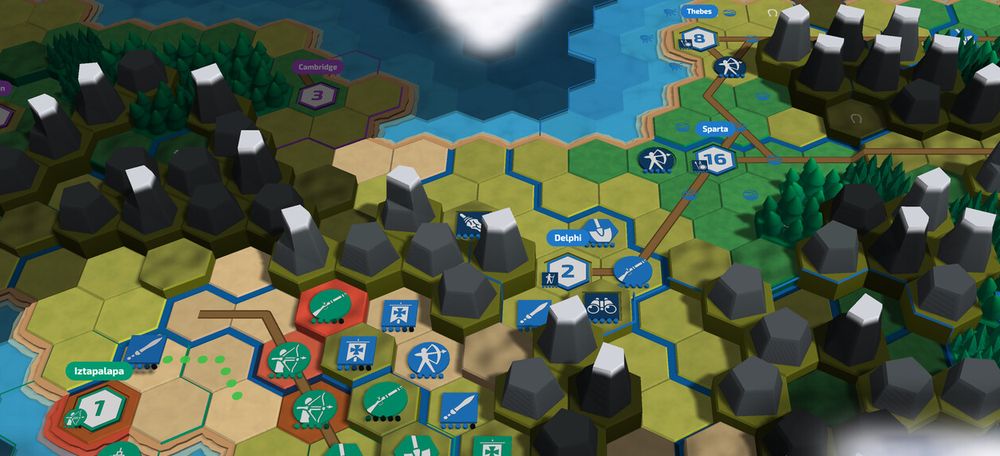
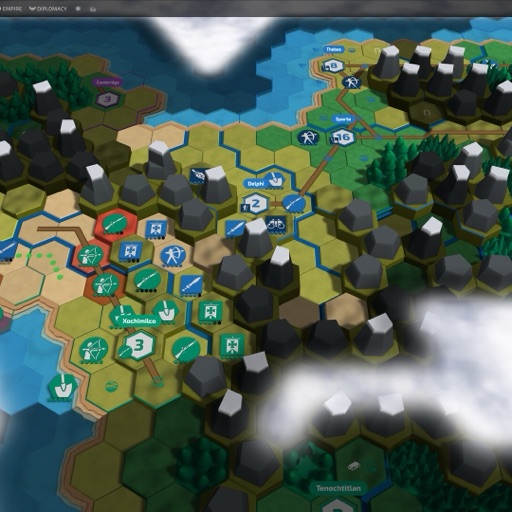
A turn-based 4X strategy game I built from scratch — custom WebGPU engine, eight civilisations, no install. Play it in your browser right now.
Back in February I wrote a piece about the thing I loved changing. The short version: forty-two years in, the craft I built an identity around had been hollowed out. Not destroyed - hollowed. I was still building, but the interesting part, the part where you wrestle a problem to the ground at two in the morning, had been compressed into a prompt and a response. I called it a fallow period and said I didn’t have a neat conclusion.
Seven months on I’ve found something. First, some history.
Before the job
I wrote my first line of code in 1983, aged seven. By the time I was fifteen I was writing things nobody asked for and nobody paid for (heck, I still am). A vertically scrolling shooter engine in 80386 assembler. A spin on the classic Star Trek game in C. Utilities. Demos. A menu system for an insurance company, which was my first taste of the horrifying idea that someone might want this stuff.
That was the bedroom coder era, and I only caught the tail of it. If I’d been a little older, and braver, I’m fairly sure I’d have been one of those people writing games for the 8-bits and selling them in plastic bags. What made it good wasn’t the hardware, though I loved the hardware. It was that one person, in one room, could hold the whole thing. Idea, design, implementation, the bit where you decide it’s finished. Nobody to hand off to. Nobody to ask permission.
The job that was still a bedroom
In 1994 I answered an ad in the local paper. Eighteen, with no real qualifications (a couple of A-Levels, school and I did not get along it’s fair to say) - but I had a demo disc, so I sent that in and got the job.
The pay was terrible, less than I’d made cleaning warehouses. The project will sound unbelievable to a modern team: there was me, and there was a hardware guy who had built a 68000-based mini telephone switch that could drive two phones, and someone using what we’d built. What was wanted was the software to drive it. That boiled down to what we’d now call a scripting language, a graphics engine for the PC, and a tiny operating system for the hardware so the scripts could actually make the phones ring. The point of all this was interactive training for horrendously complicated call centre handsets.
Amazingly, we shipped. I remember a demo disc going out on the cover of an industry magazine right as I was leaving, having worked out I was being massively underpaid and finding they wouldn’t budge.
It was a job, but it wasn’t really different from the bedroom. Two people. Every hat. The same shape, just with larger stakes.
The window opens again
I think these moments come round periodically. Something shifts, and for a while a very small group can meet what the market expects. It happened with the web, with the cloud, with mobile. I think it’s happening again with AI, on a bigger scale, horizontally.
Annhexation is the evidence I trust most, because I’ve lived every hour of it. A hex-based 4X with eight asymmetric civilisations, three victory paths, a three-layer AI and a custom WebGPU engine underneath it which I’ve designed, built and shipped in my spare time. I could have built that before but not in any timeframe that would have let me finish it and have a life. Alongside it I’ve been prototyping two other strategy games and doing a stack of software archaeology. In the day job I watch people - myself included - do things in days and weeks that would have been a quarter, and I don’t think that’s a temporary sugar rush.
For someone who has always had more ideas than hours, this is genuinely liberating.
Can anyone do it? No. I don’t think so. It still takes judgement you have to earn, and in this case two separate kinds - game design judgement and architectural judgement - and the model will still cheerfully march off a cliff in either direction if you let it. Same with UI. Same with scope. Same everywhere their is a direction to be picked and decision to be made.
The answer I said I wouldn’t give
Here’s the part I have to be straight about.
In February I wrote that there was a version of that post where I told you experience is more valuable than ever, that systems thinking and architectural judgement are the things AI can’t replace, that the craft endures in a different form. I said that version was true and that I didn’t want to write it, because it was the consolation you reach for instead of sitting with the feeling.
Reading back what I’ve just written, that’s more or less where I’ve landed. Judgement is the moat. I’ve not really arrived anywhere new.
I want to be precise about what changed, though, because it isn’t the evidence. By February I’d already been working this way for some time. I wasn’t speculating about whether judgement was still the thing that mattered - I was watching it be the thing that mattered, most days. The argument was tested, I just hadn’t finished feeling my way through it.
That’s a distinction I’d have been sniffy about twenty years ago. You can know something is true and still be somewhere in the middle of a loss, and the knowing doesn’t shorten the middle. February was a dispatch from in there. This is one from a bit further along. Nothing new arrived. I just stopped bracing.
And perhaps this is just another point in this journey. Time will tell. Perhaps in 6 months time I’m writing another piece that shifts again. These changes are huge, identity challenging.
What I described in February wasn’t a complaint about throughput. It was about intimacy. The puzzle, the chase, the moment where you finally see why the thing isn’t working. Being able to ship four times as much doesn’t answer that. It’s a different currency entirely.
So the peace isn’t that the loss healed. The loss is real and I think it’s permanent. The peace is that I’ve decided the trade is worth taking, and that I get to choose - not always, but often enough - which problems I hand over and which ones I keep for myself. Some things I still do by hand, slowly, badly, because doing them is the point. But most of the time I’m working on bigger and more intricate puzzles: such as the Annhexation AI.
The part that didn’t get easier
One more piece of honesty, because the solo-developer optimism going round at the moment tends to stop just before this bit.
Building got radically cheaper. Being found didn’t.
Annhexation is a complete 4X game, free to play in a browser, no install, no sign-up. With a commercial version on Steam. As I write this it has sixty-five wishlists on Steam. I’ve done essentially no marketing, so that number is on me and I’m working on it - but it makes the point. The bedroom coder era didn’t end because building got hard. It ended because distribution consolidated and expectations scaled, and neither of those has been touched by any of this.
The return is real on the production side. It is not remotely real on the discovery side. If you’re planning to go solo on the strength of what the tools can now do, plan for the other half too.
Three things I think shift
With the confidence levels attached, because I’d rather be useful than certain.
- Roles collapse across a lot of the industry. Reasonably confident. The people who thrive will be the ones who can exercise judgement across several domains and, importantly, evidence that they can. The evidencing part is going to be harder than the doing.
- Organisations reshape around this, particularly product-focused ones. Moderately confident on the direction, not at all on the timeline. Org charts are downstream of a lot of things that aren’t technology.
- A wave of one and two person products and companies, then teams grow again. Low confidence. This is pattern-matching more than analysis. If the historical shape holds, complexity accretes underneath rising expectations until small teams can’t hold it, and it re-inflates. But that depends entirely on how AI itself develops over the next few years, and anyone claiming to know that is selling something.
The uncomfortable question underneath all three: I got my judgement by wearing every hat for thirty years, mostly outside the corporate world (and when in it in very strange divisions), mostly by doing the work badly first. If the doing-it-badly-first stage is the bit the tools now absorb, where does the next generation’s judgement come from? I don’t have an answer. I’m not sure anyone does yet, and I’d genuinely like to hear from people thinking about it.
The thread I haven’t tied off
In February I wrote about two losses, not one. The craft was the first. The second was the promise - that the machines I fell in love with became instruments of surveillance and extraction, and that the tinkerer spirit didn’t die of natural causes so much as get bought out.
I’ve made peace with the first. I have not made peace with the second, and I’d be writing the dishonest version of this post if I let the good news about productivity paper over it. That one needs its own piece and I haven’t earned it yet.
Where this actually landed
The thing that convinced me wasn’t a productivity metric. It was a fortnight I spent on Annhexation’s AI, trying to work out why the mid-tier layer kept making decisions that were individually defensible and collectively idiotic.
No model was going to hand me that. There was no prompt for it. It was me, a notebook, a lot of instrumentation and a lot of walking the dog turning it over. The old feeling completely intact. It had been there the whole time - I’d just been looking for it in the typing, in the code, which was never really where it lived.
That’s the circle. Not that the tools gave me back what I lost, but that they took away enough of the surrounding work to make it obvious what I’d actually valued in the first place.
August 2026
Forty-two years after I first started programming, I built a browser-native 4X from scratch — a custom WebGPU engine, eight civilisations, and an AI opponent I'm still teaching to play. No install, no sign-up. Play it right now.